
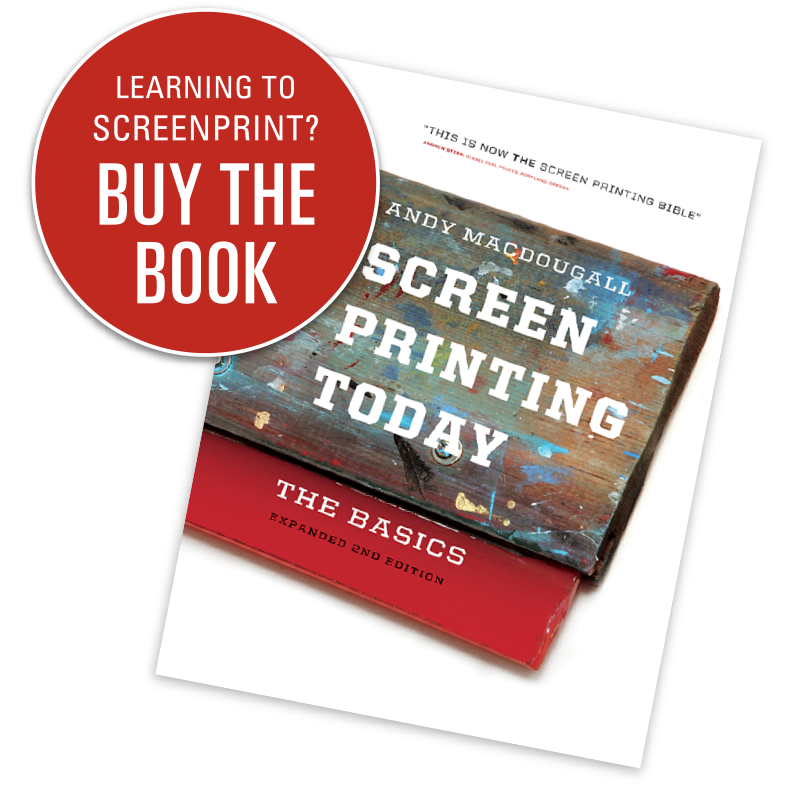
"This is now the screen printing bible." – Andrew Stern, Diesel Fuel Prints

Expanded 2nd edition now available!
click here to buy the book nowNow you can purchase an easy to understand instruction manual that breaks the screenprinting process down into steps. Loaded with tips and tricks along with lots of how-to-do-it pictures, you'll learn about art prep and film separations, screens and stencils, inks and materials, printing, specialized applications, shop safety, and more. Many available screenprinting books are out of date, or are based on fine art or hobby techniques. This one is much broader in scope – practical, technical, humourous, informative, and up-to-date, written by a person who has been involved in all aspects of commercial and fine art screenprinting for nearly 30 years. Screenprinting Today…The Basics allows the reader to learn and master the base technologies and principals behind the process, and then apply the results to their own screenprinting application.
Chapters on:
- Screenprinting History
- Applications
- Industry Prospects for Growth & Opportunities
- Preparing Art & Film
- Screens & Stencils
- Exposure
- Inks
- Make-Ready
- Press Types & How They Work
- Printing
- Safety in the Screenshop
Additional information includes:
- Solar Exposing
- Plans for Vacuum Table & T-shirt Jig
- Simple Compression Exposing system
- Printing Blends
- Printing with Waterbased Inks
- Printing fine detail and halftones
- Shopping lists for basic poster and textile set-ups
- Coating pattern test
- Calculating exposure times
Booksellers: Become our distributor in your area – Contact us
Schools: Discount for Teachers and Classrooms – Contact us
Reviews
- Iris Sautier, Graphic Designer, Montreal, Canada“Very Clear, Very Useful, and very well designed. I learned a whole lot.”
– A. Stern, Dieselfuel Prints, Portland“This is now THE Screenprinting bible!”
– D. Todaro, Ca. USA“Because of your very clear instructions, I have managed to create transparencies, expose the screens, and print with water-based inks with success the very first time…”
- B. Bradley, Australia“It's the best one I've come across regarding the technical side of screenprinting. You come over as a practical guy with heaps of knowledge.”


Andy MacDougall is a screenprinting advocate, trainer and consultant based in the Comox Valley on Vancouver Island. He's a member of the Academy of Screen Printing Technology as well as the Specialty Graphic Imaging Association and the America Poster Institute. The best way to get in touch with Andy is by sending him an email to andy@squeegeeville.com.